
Beyond Chat Memory: Making AI Interactions More Personal
Zep now connects user conversations and business data to help AI agents understand and serve users better.

Today, we're expanding what AI agents can understand about their users. Our latest Zep Cloud update automatically connects conversations with your business data, creating a rich Knowledge Graph. This context enables agents to give more relevant, personalized responses and solve more challenging problems. It's a step toward our mission of building agents that deliver real value by deeply understanding users.
We built this because we believe effective AI agents require more than conversation memory alone—they need to understand the full context of who they're helping and why.
How it works
Zep can now ingest JSON data and unstructured text alongside chat histories and other artifacts of user/agent interaction. Zep autonomously builds a knowledge graph from this data while handling changing relationships and maintaining historical context.
Zep generates facts from relationships identified in the graph and associates them with a user. Alternatively, developers can add data to a graph belonging to a group of users, allowing for knowledge to be shared across many users.
As Zep incorporates new information, outdated facts are marked as invalid. Retaining a history of facts enables agents to reason with changing user state.
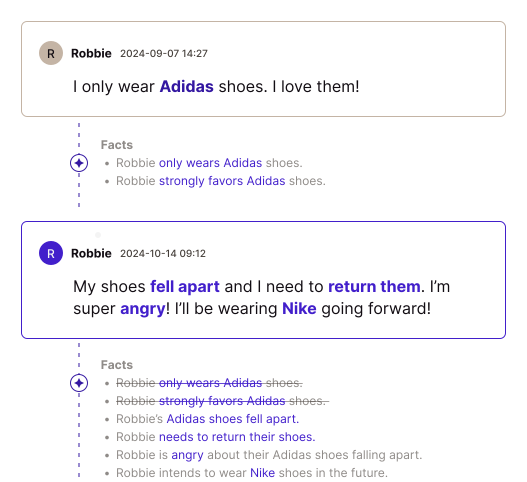
Facts relevant to your agent's task or the current conversation with a user may be retrieved from Zep, ensuring your agent knows to complete the task or respond appropriately.
A Fictional Case Study
In a stylized case study, PaintWiz is a fictional AI painting tool. Emily, an artist using PaintWiz, contacts SupportBot, the Tool's AI support agent, for help as she can't log in to her account.
We've loaded into Zep a product knowledge base (including password reset instructions), real-time billing and account status data, past SupportBot chat conversations, and historical support cases from our CRM.
Emily complains that she is unable to log in. SupportBot retrieves Emily's graph node, which summarizes facts adjacent to her user node in the graph. Additionally, Zep retrieves facts relevant to Emily's message, "I can't log in."
Using this context, SupportBot identifies that Emily's account is suspended due to non-payment. Rather than responding with a generic article guiding Emily to reset her password, SupportBot is able to provide specific instructions on how Emily can re-enable her account.
New APIs in Zep's Python, TypeScript, and Go SDKs
Alongside Zep's memory API, all SDKs now offer a graph API. This supports adding JSON or text data to the graph, CRUD operations, and search.
# The lower-level data API adds arbitrary data to a user # or user group's Knowledge Graph.await zep.graph.add( user_id=user_id, data=transactions, type="json",) # Flexible graph search API, enabling search across different# entities using various search and reranking strategiessearch_results = await client.graph.search( user_id=user_id, query=query, reranker="node_distance", center_node_uuid=center_node_uuid,)Developers can construct sophisticated agent tools using Zep's graph search API. Semantic similarity and full-text BM25 search are offered, and various rerankers are available, including Reciprocal Rank Fusion, Maximal Marginal Relevance, Node Distance, and Episode Mentions.
Availability
Zep's new Knowledge Graph memory engine is available for all new signups to Zep Cloud. All Customers will be migrated by December 31, 2024. Contact us if you'd like to access these features sooner!
Data ingestion limits may apply to Free and Team tier accounts.
Next Steps
- Read the Zep Graph documentation.
- Sign up for a Zep account.


