

What is a company brain and what does it let agents do?
Agents have the intelligence to do the job. They often lack the knowledge to do it right. A company brain gives agents the knowledge they need to complete work reliably.

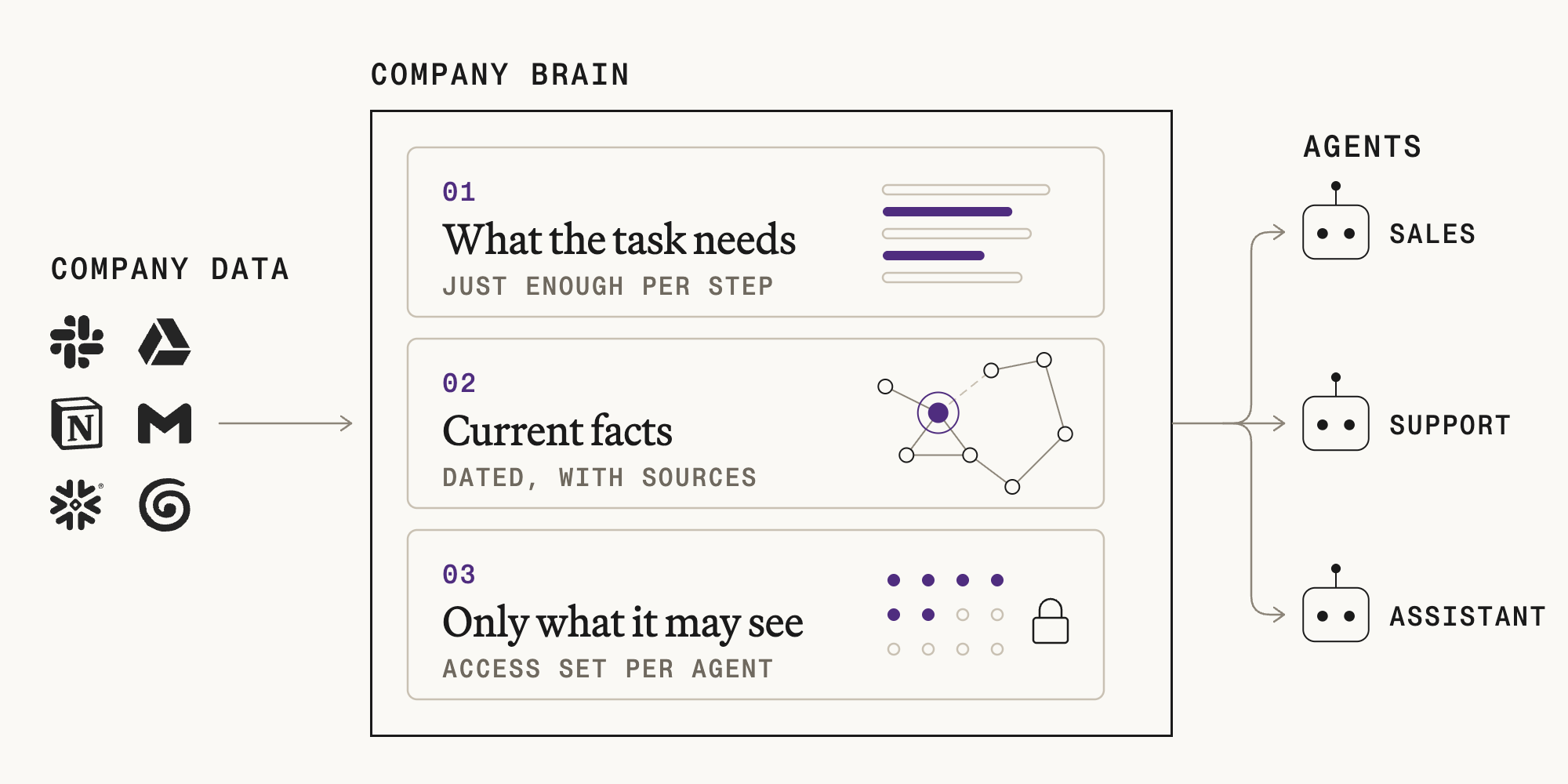
A company brain is the infrastructure layer between a company's data and its agents. It keeps company knowledge up to date and structured for agents to retrieve, while controlling what each agent can see. That control is what makes it safe to hand agents real work. An agent finds the current answer on its own, and it never sees what the person it works for isn't allowed to see.
More than a dozen companies have described their own version of a company brain since December 2025. Uber, Stripe, Ramp and Airbnb are among them. Many more teams have tried and given up.
What teams have built so far
The term spread in the spring of 2026, and it still names very different builds. Shopify's River is a Slack agent with memory. Meta and Garry Tan's GBrain keep knowledge in files that experts correct. Bold.org's agent queries live systems with read-only access. Uber built a graph of 24 million nodes from more than 30 internal systems.
Despite the different stores, the builds have a common aim. Each puts the company's knowledge in one place that agents can reach. They vary most in how they keep this company knowledge current as work happens. Most add written procedures, such as skills or playbooks, and the people who own the work review them.
What a company brain should give agents
However it's built, a company brain should give agents three things.
- What the task needs. An agent works best with the context the current step requires. The brain hands over that much and lets the agent ask for more, which keeps answers accurate and token costs down.
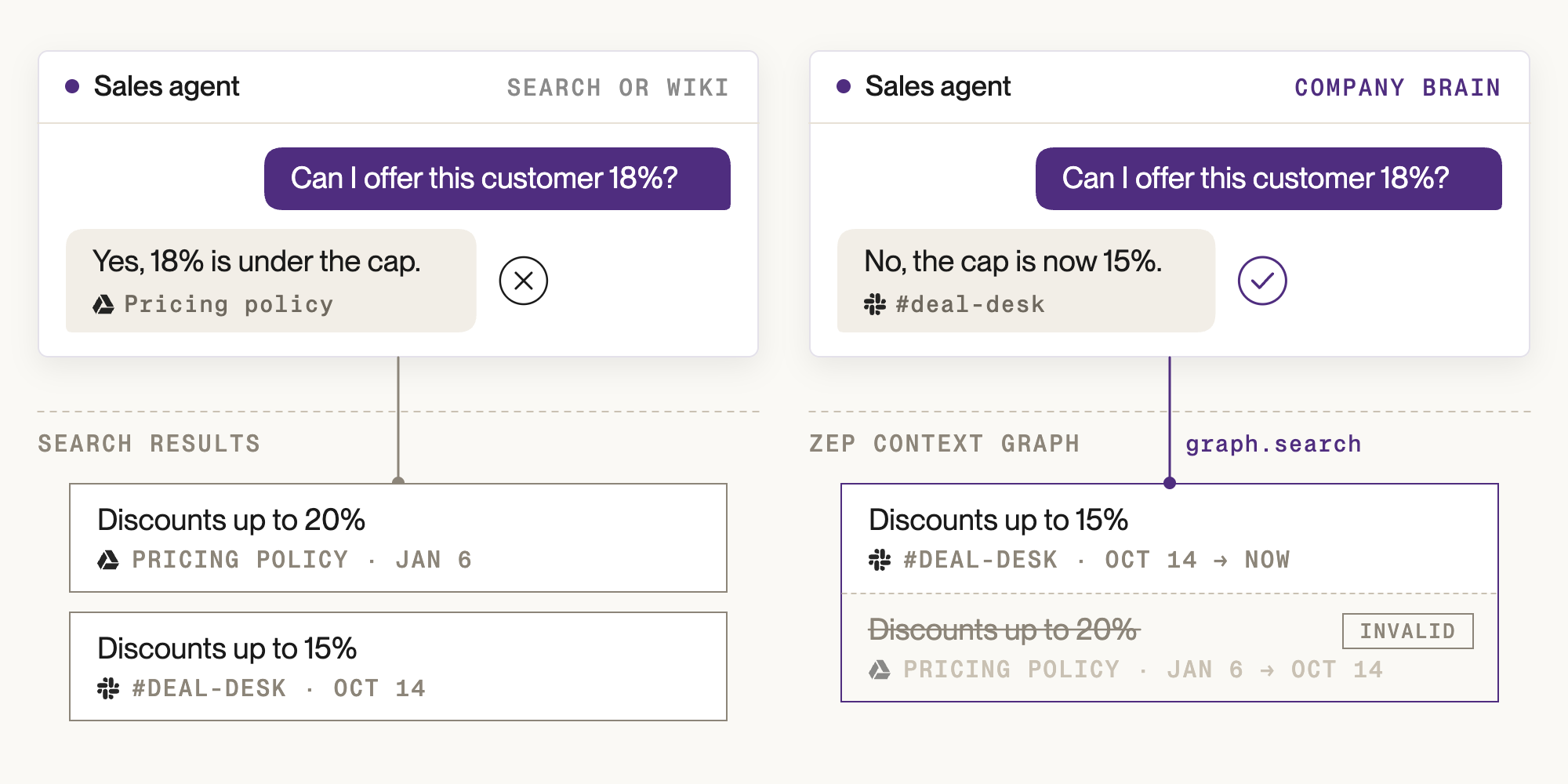
- Facts that are current. Company facts change. The brain keeps each fact with when it was true and where it came from, and it marks a fact replaced when a newer one contradicts it.
- Only what the agent may see. Each agent sees what the person or team it works for is allowed to see, and nothing more. The brain sets that access and enforces it every time an agent retrieves context.
Builds that get all three right give agents context they can act on. Most that stall skip at least one.
What agents can do with one
A company brain does more than speed up work that used to wait on a person. It lets agents take on work nobody had time to do. At Ramp, people used to copy about 300 feature requests a month from customer calls into Salesforce by hand. Ramp's internal AI now captures 20,000 a month straight from the calls. It also ranks them and emails each customer when their request ships.
The same context makes everyday work faster. An agent can answer a data question without a ticket to the data team. It can handle a pricing exception the way the company handles it because it knows pricing rules and the customer's history itself.
One company brain also serves every agent. A sales agent, a support agent and the assistants people use read the same current facts. A correction made once reaches all of them.
Teams that built one report large gains.
| Company | What the agents do | Reported result |
|---|---|---|
| Uber | Engineering and data questions | 38 seconds and right, against 20 minutes and wrong |
| Ramp | Feature requests from customer calls | About 300 to 20,000 captured a month |
| Data questions | Acceptable answers from 25.9% to 79.5% | |
| Vercel | Data questions in Slack | Success from 80% to 100%, 37% fewer tokens |
| Shopify | Requests in Slack, including code | Merge rate from 36% to 77% |
| Meta | Data pipeline engineering | About 80% fewer tokens per turn |
| Bold.org | Investigations | Multiple hours down to under one |
| Stripe | Work across company tools | 83% of employees use it weekly |
Results as each company reports them.
The largest gains come where agents had been searching blind, as at Uber and LinkedIn. Without the graph, Uber's agent spent 20 minutes inspecting service code. It started two subagents and hit three errors. Then it wrongly concluded that the data couldn't be queried.
Compared with search and LLM wikis
Enterprise search indexes a company's documents and messages across its apps and returns ranked results for a query. It serves people well. A person can read the results and decide which one is current, and they only see what their permissions allow. An agent can call search too. It gets the same pile of documents, and it has to make the same judgment without the broader context a person has, such as knowing that a later Slack thread overruled the policy it found.
An LLM wiki follows the pattern coding agents use for a codebase. Agents keep what they know in markdown files in a repository and help keep those files current. That works for codebases because code is a deterministic source of knowledge. What the code does is written in the code itself, and every change shows up in a pull request, where the notes can change with it.
Company facts mostly change outside codebases. A pricing rule changes in a Slack thread. A customer's terms change in the CRM. A decision gets made in a meeting. No pull request flags them.
Access is the other gap. Repo access is all or nothing, so a wiki can't limit a note to one agent or person. Any agent that can read the repo can read every note in it, from pricing floors to a customer's contract terms.
A pipeline built for one agent avoids those problems for that agent, and the next agent needs another pipeline. A company brain serves every agent with current facts, their sources and the procedures to follow.
| Enterprise search | LLM wiki in git | A pipeline per agent | Company brain | |
|---|---|---|---|---|
| Serves | People | Agents in one repo | One agent | Every agent |
| Returns | Documents | Files the agent opens | What the pipeline built | Current facts and procedures |
| When a fact changes | Old and new both rank | Edited by pull request | The pipeline is rebuilt | Old fact gets an end date |
| Access | Source permissions | Repo access, all or nothing | Set per pipeline | Set per agent and group |
Search and wikis each win a row, and only a company brain serves every agent current facts.
Why teams are building now
Agents already do well where they have complete context. A coding agent can read the whole codebase, its history and its tests. Coding and chatbots take 76% of the $77.3 billion spent on AI applications, and Menlo Ventures' 2026 report credits conditions like these. Most company work has nothing like a codebase. The rules, decisions and history an agent needs are spread across Slack, documents and business systems.
A company brain is a prerequisite for knowledge work agents to complete tasks. It gives company work what the codebase gives coding agents, one place to find what's true and how the work gets done.
Why most company brains stall
Most teams that try to build a company brain don't get there. Slite surveyed 149 self-selected, AI-forward teams in July 2026. Only 19.6% have a company brain that works, and 24% tried and gave up. Among the teams that built their own, 55% gave up, almost always on maintenance.
Most stall because they're built to collect knowledge as a one-time exercise. Collecting is the easy part. The work that matters starts after the first import, when facts change and every agent needs its own slice of what the company knows. Each way a build stalls traces back to one of the three things above.
Facts change. A policy changes in Slack, and the brain keeps serving the old version. The agent doesn't know and makes the wrong decision. Meta's engineers found that decaying context does more harm than none. Re-importing on a schedule or ranking newer notes higher doesn't tell an agent which fact replaced which. The brain has to record when each fact stopped being true.
Access is bolted on late. In Slite's survey, teams above 50 people are nearly five times as likely to say they aren't allowed to build a company brain. Their security teams have a point. Once a brain combines several tools, the source permissions no longer say who should see the result. Access has to be set for each agent and person, and it has to be enforced when the agent retrieves context.
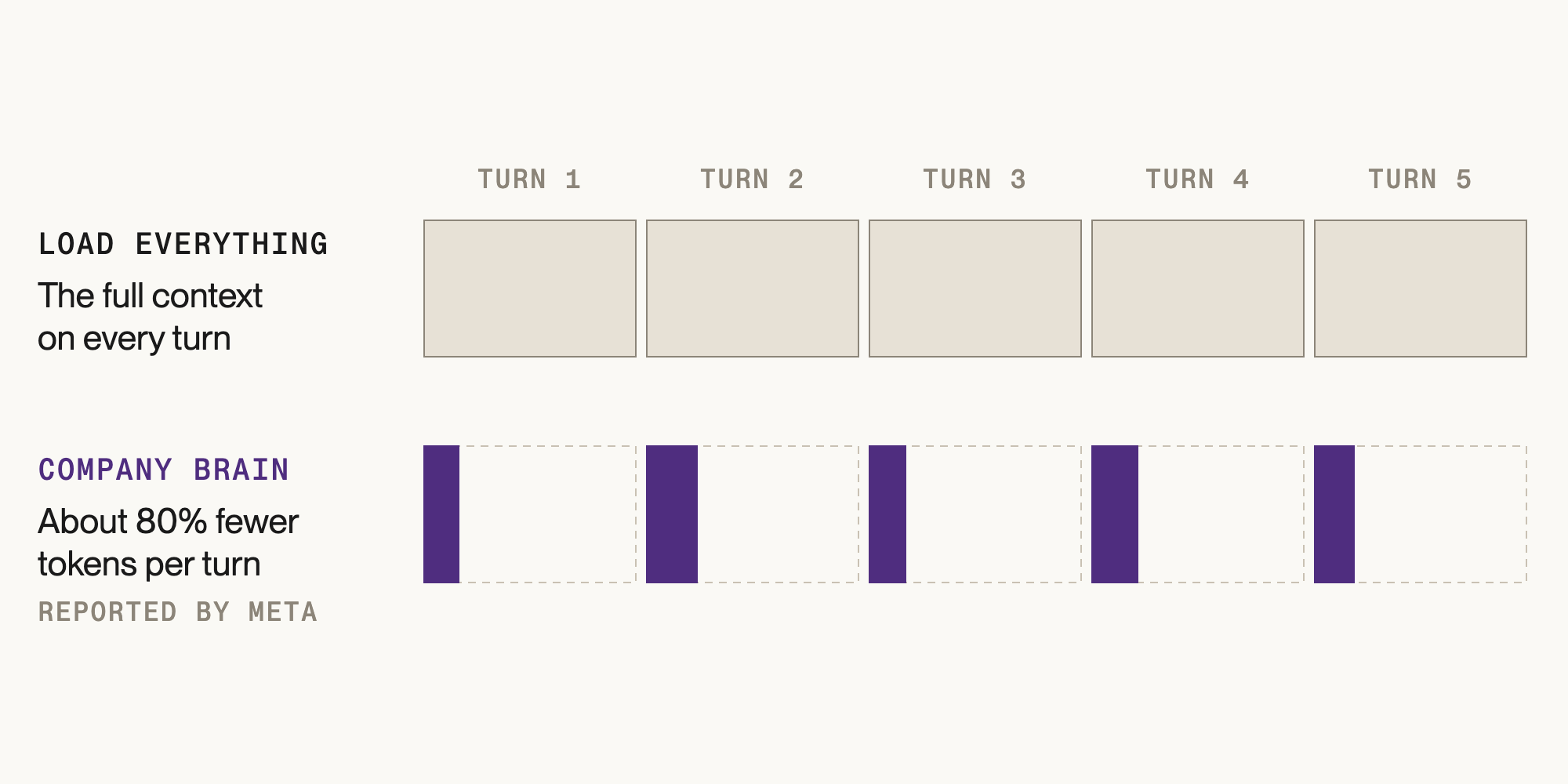
Agents get too much. Loading everything into an agent costs more and hurts performance. Every token in the context is paid for on every turn, so a bloated context makes each task more expensive. Meta reports about 80% fewer tokens per turn after giving its agents structured knowledge files. Long contexts also hurt accuracy. Chroma tested 18 models and found their performance grows less reliable as the input gets longer. The brain has to hand over just what each step needs.
Upkeep and proof follow from these. When facts don't update on their own, someone has to feed the brain by hand, and 55% of the teams that built their own gave up on that maintenance. When nobody tests the brain against changed facts and off-limits facts, nobody can say whether it works.
How Zep builds one
Zep builds a company brain on the Context Lake, which unifies business data into governed context for agents. Slack, Google Drive, Notion, Gmail, Granola, Microsoft Teams, SharePoint, Snowflake, Databricks and BigQuery connect to the Zep platform.
Facts go into context graphs, where each fact keeps the dates it was true and the source it came from. When a newer fact contradicts an older one, the older fact gets an end date. Agents can still see what was true before. Agents retrieve from the graphs through the SDK or the MCP server, a step at a time. On the Enterprise plan, access policies set what each agent and user group can reach. With Zep Agent Skills, your agents learn procedures from their own runs and keep them as skills.
To see it on your own data, request a demo.
Questions before you build or buy
A company brain touches every team, so the questions cross team lines. These four are worth settling first.
- Outcomes. Which tasks will agents finish that they can't today, and how will we measure the change?
- Changing facts. When a policy changes in Slack, how does the agent find out?
- Access. Do agents respect the access controls on the underlying data, including when an answer draws on several systems?
- Upkeep. Who keeps the brain current, and how much of that work happens on its own?
FAQ
What is a company brain?
A company brain is the infrastructure layer between a company's data and its agents. It keeps company knowledge up to date and structured for agents to retrieve, while controlling what each agent can see. That knowledge comes from tools such as Slack, Google Drive and the CRM. A company brain also holds the procedures agents follow. With one, agents finish work that would otherwise wait on a person.
Is a company brain the same as enterprise search?
No. Enterprise search returns documents for a person to read and judge, with each source's permissions applied. A company brain gives an agent the current fact and its source, along with the procedure for acting on it. When two documents disagree, search returns both. A company brain built on a context graph records which fact replaced the other, and when.
Is an LLM wiki a company brain?
An LLM wiki can serve as one for a small team. It's a set of markdown files that an LLM builds and maintains, and it works well for knowledge that changes in the same repo, like code. Company facts mostly change in Slack, the CRM and meetings. No pull request flags a stale note there. Repo access is also all or nothing, so a wiki can't limit a note to one team.
Should we build a company brain or buy one?
Most public company brains are built in-house. Buying the infrastructure layer lets your team spend its time on the agents. Zep provides that layer. It keeps facts current and sets access per agent, so your team can build the agents your work needs.
How can several AI agents share one company brain?
Each agent reads from the same store through an API or an MCP server, and the store applies access rules for each agent and user. A sales agent, a support agent and a team assistant then get the same current facts without a pipeline each. A correction made once reaches every agent that reads the brain. Access rules keep each agent to the context it's allowed to see.


